May 9-10 Turtles & Birds, oh my!

May 9

Happy Birthday to my sister, Diana Fox.

Edisto (ED isto) is a barrier island and still recovering from Hurricane Matthew. The whole beach campground was destroyed and hasn’t been rebuilt – to date. This beach town reminds us of Dauphin Island, AL. This is a family place that hasn’t seen the huge commercial development or beach hogging condo-towers of most of the rest of the southern coast and gulf coast. Bike trails, people walking, one grocery, one gas station, a couple of gift shops and lots of houses that have been here a long time and weathered many a storm. There are pathways between beach houses for folks to get to the beach, even!

Loggerhead turtles nest here and are in the process right now. There is an active SC Marine Turtle Conservation Program whose volunteers and staff are busy trying to keep the loggerheads from heading to house lights instead of back to the water. 120 turtles, including a bunch of mother daughter pairs are nesting. Some turtles next several times in a season. Each one is tracked and their nests are counted over the years. One turtle has been nesting here since 2012 and has built 7 nests!

In 2008 someone brought a badly injured female whose carapace had been cut by a propeller in to the Marine research and . She was healed and finally released in 2013 and scientists have found evidence that she came back here to nest last year.

It’s really a tragedy that the entire Marine Research Sea Grant Program, is threatened by a cut of 30 million dollars here in South Carolina alone ($74 billion nationwide) when all “Non-Defense” funding was cut drastically by FY17’s Security Supplemental Budget . The work they do protecting coastal and other species and teaching humans how to enjoy and not destroy the environment plays a critical part in keeping our planet healthy.

May 10

We got the rig moved to the new site and cats tied out. They approve of this site as much as the last one and immediately began exploring in the brush surrounding the RV.

We headed out to the Interpretive Center on our bikes, with the intention of bike birding. Bike birding is when you cruise along, eyes glued to the layers of bird habitat; ground, up to 8’, 8 to 20’ and the top story of trees. When one spots a bird, scratch to a halt, stand supporting the bike and get those binoculars up! Today’s ride netted us Carolina Wren, Eastern Kingbird, Black and White Warbler, Painted Bunting, Carolina Wren, Eastern Blue Bird, Turkey and Black Vultures, Red Bellied Woodpecker, Great Egret, Laughing Gull, Wimbrel, Canada Geese, Brown Pelican, Osprey and Red-Winged Blackbirds. The Red Trail takes you through lots of different habitat, as you can see.

The Interpretive Center holds displays showing local sea and pluff (the marshy mud) creatures around every turn. Interesting information on local culture, plantation culture and farming the Edisto Island area. Lots of Islands – on maps they show as solid land but they are considered islands because one can’t get across the marsh pluff without a bridge. The Center is made of as many recycled materials as possible, situated in a way that would least disturb the environment and is surrounded by permeable concrete (to trap water and let it filter through the soil rather than run off into the waterways).

Great Day!
May 6 – 8 Learning Curve and Lizzy Looses Their Way

May 6

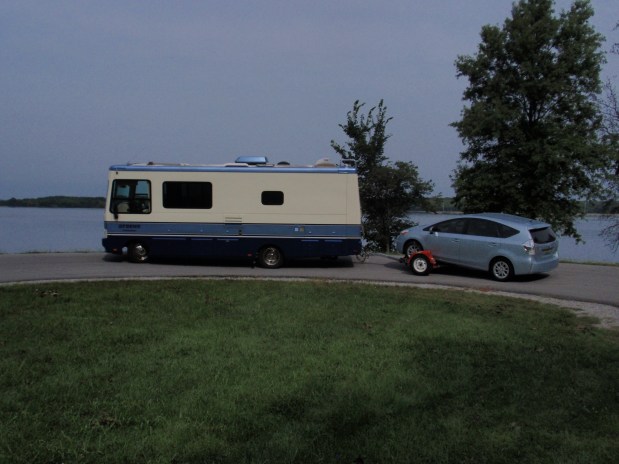
Our traditional Hudson’s Bay Stop at a park nearby (5 mi from home) was successful. After discovering at least 3 lists of “Oh, we need the…” and “Shoot, I forgot the…” We slept well, loaded up the bicycles, hooked up the car and hit the road.

May 7

In the planning of this trip the decision was made to drive a long day to get to a Seminole State Park in Georgia. It was a LONG drive. We decided we would NOT do that kind of drive again. Avoiding the freeway was a blessing and curse, as many of you know. Freeways are fast. Freeways are boring and gas is more expensive near the cloverleafs (cloverleaves?). The small roads were not at all boring, gas was super inexpensive and there were lots of interesting town centers with gorgeous churches and courthouses to enjoy.

Seminole SP is pretty isolated and it takes quite a drive to get up over to the campground. The park was lovely! We parked right on the lake. With only 6 other campers in the whole place, I got to practice morning yoga down by the lake in complete solitude. After meditation, my eyes opened to a low pale grey mist moving slowly over the surface of the lake, as the sun rose peaching the water. Peace.

May 8

When we were driving to our next stop, the check engine light came on. We pulled over for a bit to pull out the Scan Gauge and give a quick diagnostic check. Code P0327 showed that there was something going on. When we checked the codes at http://www.obd-codes.com, we discovered the code has to do with the engine knock sensor. Barb is going to multi-meter the wires later to see where the problem originates. We got back on the road and proceeded to the Edisto Beach State Park in South Carolina.

This trip was our first using the GoodSamClub Trip Planner, GoogleMaps, paper maps and Allstays. True to my semi-dyslexic form… I got things backward and we ended up at the wrong State Park and missed one we really wanted to go to. The schedule had been for us to make an easy drive over to Jekyll Island State Park Campground (not reservable through the State Park System but through a concessionaire). I got really mixed up because I’d printed out all of the reservations from Reserve America and Jekyll Island was not on the list. Sigh.

Many phone calls later, this morning, we got things mostly straightened out. I need adult supervision when putting papers in order and making lists. Luckily all of those resources helped get us on the right track again! We arrived at Edisto Beach State Park safely and cadged the last open site from Tori, the Problem-Solving ranger. We move to our originally booked site on the 10th. Yikes.

Time Flew By!

Time Flew By!

Boy, has a lot changed since we last posted! Life has a way of doing that, I suppose.

Barb decided to go back to school to become a Nationally Certified (by RVIA/RVDA) RV Technician and then went back to work!!! First with Camping World where shop policy and quality didn’t mesh with her sense of ethics.  She looked around and found a great job working as mobile and shop Tech for Cherokee Farms RV Center in Foley – a wonderful shop run by a terrific family led by Bobby Tarver. If you’re around the Gulf Coast of Alabama, give them a whistle.

On April 30 she said “Adios, for now!” and began a few months hiatus so we can hit the road for a few months. We hope to see you out there.  She’ll be available to help other RV’ers while we’re on our way. We’re on RVillage.com, so you can check in there for more news of where we’ll be.

We also made a big decision! To sell the 2430 and get a bigger RV. The 24′ was great if we left behind all of Barb’s RV Tech tools etc. We sold the ’97 after buying a 2007 Safari Trek RB2, 29′ by Monaco.

I have to share that a two day stint on Craigslist was all it took to find the Blue Sea Cafe a new home. Treks have great resale value (find one on Trek Trax. Her new owner is Zack Starr, founder of Vet Connect an organization seeking to provide information on services for veterans. Check out his site VetConnect.  Zack hiked the whole Pacific Crest Trail and has a movie about his experience called “The Epic Mile.” He’ll be traveling the USA in the blue Trek (renamed Leoa) connecting with veteran’s service organizations. We were so delighted to sell her to this hard working veteran.

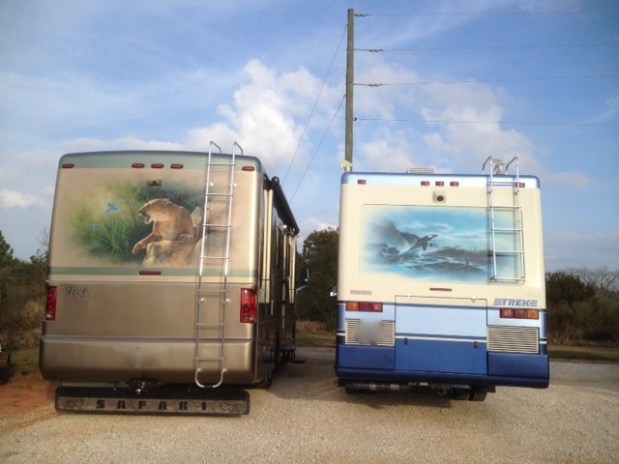
We stayed with the Safari Trek model, however, the new one was made by Monaco instead of Safari. This gem is our third Trek. The RB2 floorplan is the same as the 2830 of Safari fame – the bed lowers out of the living area ceiling. Not hauling around that extra 8+ feet for a bed gives us lots of maneuverability. She is, as yet unnamed but we’re thinking something catlike, as her mural is of a gorgeous cat – lioness or cougar? We are lucky that the original owners left us a pencil sketch of the mural by Dennis Dame, painter and long time Trek muralist.

So, here we are, going through the whole “Getting Started” (see earlier posts) process again, I laughed as I read them… and made some notes. I feel like we hit the repeat button!

We leave in 6 days for a trip east to visit old friends living in South Carolina. Planning to see some of Georgia’s most lovely state parks and to putter up the coast to visit even more gorgeous places. Jekyll Island here we come!

I’ll miss being home because I won’t see my friends Max, Emma & Emily every day. I am sending postcards and photos to them though, so we can keep in touch.

Hoping for enough wifi to post some photos and thoughts about the journey. So pop back in to see what we’re up to.  It would be great to hear from you, feel free to ask questions and post comments.

L8rs and don’t forget to breathe!

Getting Ready to Go: The process (part One)

Liz

Barb gave some good advice in her post “Getting Ready to Go: Assembling the gear.” Now lets look at things in more detail. On this trip, it was my responsibility to think -‘inside the box’- since I’d be taking care of what went inside the home we would be in for around 6 weeks. I’m going to detail the process I went though to prepare creature comforts area of the RV. If we were planning to full-time again, I would use that same process for the same reasons.

This will be a basic “How To” guide anyone can follow for their RV life.

Think of the RV as a house. In my house are the following rooms:

  • Office
  • Living Room
  • Kitchen/Dining Room
  • Bedroom
  • ‘Dressing Room’
  • Bathroom

So, that’s where we’re going to start. I thought of the RV as divided into rooms. Each room would need things in it to meet the requirements of the places we were going.

We planned to be gone for about 6 weeks and would transit some climate zones and exciting food regions. Flexibility would be key to being comfortable and prepared for what we found to do, eat and see.

I deconstructed the trip by using the map and calendar. Traveling from the warm, humid South in October to the freezing cold of the New Mexico mountains in November and back to the South in December required flexibility when loading the RV. I thought first about physical comfort and the things we would be doing in each climate zone in which we stayed.

From the South we’d need shorts and t-shirts, comfy shoes and light bedclothes. In the cold North we would want super warm blankets & bedding; jackets; shirts and pants; leggings or tights; boots or shoes and sox. Since these extremes wouldn’t do well for transitional areas, we would need layers.

Available foods would also change regionally. In the heat, we lean toward lighter food like salads and grilled foods to cook outside. In the cold, we go for soups, casseroles (that also warm up the RV while they cook) and heavier veggies like winter squash and roots. Supplies needed to reflect those preferences. Grilling in the snow is do-able but not comfortable. A lot of what we eat and how we eat has to do with the foods available locally and local specialties: like pecans and Gulf shrimp in the South. In the West we would be enjoying Hatch chilis and Tex-Mex cooking.

The areas including office, bathroom and living room supplies have things that are more consistent than the other rooms with some additions for when the weather changed. For example adding lip balm, heavier hair conditioner and body cream made the dry, cold of New Mexico more comfortable.

Check-lists are handy sometimes so, here’s an article from “RVing: A Fun Times Guide Site”. Read through to find a whole bunch of lists to help folks from the decision to buy an RV to hitting the road and staying on the way safely.

We used a list for checking out potential Trek RVs. We found it in the NWFC Trek Tracks Forum.

Since I’m not a list person, I tend to loose the list and when I have one I still end up doing things differently anyway. I needed to think my way through the process of loading our home on wheels and I didn’t use any of the lists.

Before gathering anything, I decided to cut-to-fit and use light colored nonslip, grippy shelf liner in the cupboards and drawers. It would keep things from sliding and prevent fall-outs. I put it in all of the cupboards in the RV and all drawers. I had already replaced worn out cupboard latches, so knew they would hold. To open drawers we simply lift them slightly from their nested positions – so they weren’t opening either.

Starting in the Office: Our RV doesn’t have a dedicated office, so a cupboard and drawer would be dedicated to office type items. We planned to use the dining table for a desk and could also use a lap tray (I made one from old jeans fabric filled with cotton batting and stapled to a piece of 1/4” plywood. I cut the plywood, sanded and rounded the corners, finished it with polyacrylic and glued down a rectangle of the non-slip mesh we used inside the cupboards and drawers to keep whatever was set on it from sliding).

In the dedicated-to-office upper cupboard, we put a plastic box with an integrated lid to hold chargers and surge suppressors when they weren’t being used. A fabric covered box with a flap lid, turned on it’s side faced the door and held books, small gifts for the kids and our small portable game bag (checkers, chess, backgammon, cards games and dice in a bag about 7”x10”). Barb’s important papers accordion file was in the cupboard and our handhelds (iPad and Kindle) started the journey in there. The laptop, in it’s padded bag, slid in next to the pedestal “coffee table” between the two chairs.

We hoped to get in some sketching, watercolor and perhaps work on crafts. I narrowed things down, gathered and decided to put them in the cupboard next to the office, over the dash. That cupboard held my traveling bead box and beading kit; a plastic box with watercolors, Zen Tangle pens, colored markers and little loose items fit against those boxes and several sketch books and watercolor paper pads stood upright against the wall.

Moving to the Living Room. Under the couch (a jack knife style bed) we stored the extra 2 folding dining chairs and the vacuum cleaner. The coffee table pedestal held boots and shoes – easy access near the exit door. Each of the chairs, bulky wooden chairs built by the previous owner, Dick, and their lift up seat bottoms held extra wine, walking poles, the tripod and the Red Box of the Trek manuals and a notebook of what had been done to the Trek maintenance and repair wise. The chairs make into a bed when the cushions and table top are slightly rearranged – very handy when the grandkids stay over. Dick did a good job building and finishing them – Marcia had made the seats and back support cushions & look like they were made professionally.

This post is lengthy enough. I’ll cover the rest of the ‘house’ in the next post.

Breathe!

Getting Ready to Go: Assembling the Gear

Getting Ready to Go – Assembling the Gear

I, Barb, quit work on Labor Day September 7, 2015. Fitting, I think. Our maiden voyage departure date was to be around October 23, 2015. That gave 7 weeks to get The BluSea Cafe packed and the house closed up. Plenty of time!

It’s been 15 years since we did this and I’d forgotten everything that needs to be considered during preparation. Seems like last time we just hopped in and took off. To give you an leg up on preparation I’ll go through the rig as it was at departure and recap what we found to be essential to bring on board.

Expandable file folio (yes, I’m the bookkeeper and naturally would start here) to keep receipts, medical information, stamps (both 1st class and postcard), envelopes and important mail that has been forwarded, passports for the unexpected trip over the border and passwords for web sites unless you have them stored on your phone or elsewhere.

Also in the folder is medical information: medication list, Advance Care Directives, insurance information and any relevant medical history that can be passed on to doctors if the need arises. We travel with cats so their licenses and rabies info are included here in too.

Box with electronic gear: all device chargers and small (Belkin BST-300bg) surge suppressers.

Maps and campground information. I know all this can be available online, but if you are in the middle of nowhere with no internet access, what good are all the apps in the world? Might be old fashioned, but I like the feel of a map or state campground directory (available at state Welcome Centers) in my hands occasionally.

We have a junk drawer that contains a plug in polarity meter for checking interior receptacles when plugged in at campgrounds, the dongle for determining what code comes up when the “Check Engine Light” illuminates on the dash (more about this when we discuss the rig maintenance stuff), a bag to collect quarters for laundry days, the Swiss Army knife, extra key for the Toad and whatever small things that usually end up in the junk drawer. Yours will be different than ours, no doubt.

Dishes should be light weight (we use Corelle, thin and not too heavy; don’t like plastic dishes), We use thin, Bp free, Govino wine glasses for drinking anything except wine (glass for that), they work inside and outside. Cooking vessels are specific to your needs and set up in your galley. We have a micro-convection oven and didn’t plan to make cakes on the road, so ended up purchasing a bundt pan, hand mixer and nice set of mixing bowls (nicer than we use at home, with rubber bottom for no slip) so Liz could make a couple birthday cakes for son Gabe. For us, a cast iron pan & griddle are essential, albeit heavy, as I love Liz’s pancakes and we like grilled sandwiches.

We have a counter top Multipure water filter which is the best for reducing a wide range of contaminants that affect both the healthfulness and the aesthetics of water. It stows in the sink while underway. We use stainless steel Hydro- Flask water bottles from Amazon or REI that will keep beverages either hot or cold. Hate those throw away plastic water bottles. Did you know that unless they are biodegradable it takes over 70 years for those bottles to decompose, (That’s another topic.)

Clothes are up to the individual but think layers, rain gear, rubber slippers for the community showers or beach, hats, comfortable hanging out clothes, a set of work pants and shirt for the dirty days. Since there aren’t lots of drawers, we put hanging cloth shelves in the closet. Light weight and everything visible. We used the rest of the closet bar for coats etc.

Bathroom stuff is also individual but remember some sort of bag in which to bring clothes and toiletries to the shower. We are still working on that ideal bag and will keep you posted. It’s important to remember eye drops, nose drops, sunscreen + lip protector, bug juice and any medication or OTC stuff you use at home treat eye, ear, nose and throat issues. Bring extra personal medications, it can be a hassle to have to transfer prescriptions and some states bar out-of-state doctors’ prescriptions.

Our essential accessories: camera with lenses, scope, binoculars and bird book of the region. Bird lists you can pick up on site. Tripod to use for camera, scope and binos. Walking sticks and butt packs which we like better than back packs.

Of course this isn’t everything, but this list will give a good start to stocking the interior of an RV for your voyage. We’ll address items stored in outside compartments and stocking the kitchen soon.

Breathe!

Progress and The Beginning

Progress and The Beginning

The Beginning:

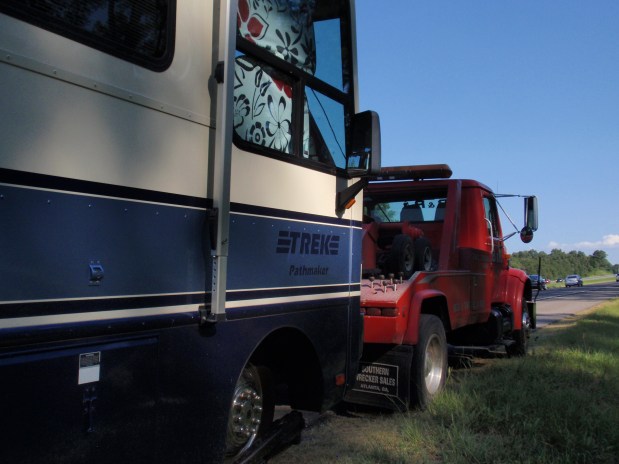
After we bought our Safari Trek, we had some work to do. She broke down on the way home from the sale and was about 2 weeks in a shop up in Montgomery getting diagnosed and repaired. We went to pick her up and she broke down at the next rest stop down the I-65. Luckily Russell Truck Repair sent a mechanic down to fix the Serpentine Belt. Now we know how to do that. Luckily the previous owners, Dick and Marcia, left one for us in the RV so we didn’t have to wait for parts. We had a few other mechanical issues to solve after that though.

One of the front air bag shocks was broken so we got that repaired, the exhaust manifold was trashed so that got done, bought new tires and we installed the Tire Tracker TPM system before we left the tire shop. We got tons of information on choosing tires and the TPMS from the RV Tire Guy, Roger Marble.

We cleaned the interior and exterior extensively, an 18 year old rig has seen some wear! We deferred some things (new flooring and cab seats) until we returned. Then, we began stocking the rig for our trip. We were surprised to learn just how much less basement storage there is on the 2430 model vs. the 2830! Oh well, we bought a smaller RV because we wanted to lighten up and get in to even smaller campgrounds. The interior, though, has ample storage for extended travel for two.

Next post, Barb will talk about how we decided what to take and how much of it to bring.

Breathe!

Intro to The BluSea Cafe


When we bought our 1997 RV, The BluSea Cafe, we had to learn to drive a land yacht again, how to stock it for travel and how to fix the A/C & water system, to take power back to the car we tow (the toad or dingy) and hook it up safely, and to live in a very small space together.

How did The BluSea Cafe get it’s name? On the back of Trek Class A Motorhome you usually find a hand painted mural. Our blue RV has a mural of a couple of killer whales playing in blue waters. So the BluSea makes sense. The Cafe part comes from our first road trip. We went up to Santa Fe, NM (over 4 weeks) to spend Thanksgiving with all the kids and grands. One day, with one cast iron pan, we served sourdough buckwheat (GF) pancakes, french toast, bacon, and fruit salad to all eleven of us. Everyone ate outside at the picnic table in the cold sun. It was amazing! So she got called a cafe and it stuck.

Thanks for stopping by!

Breathe!